
How to Configure a Basalt Plant for Coarse Aggregate and Manufactured Sand
2026-11-11
Two quarries can process similar basalt and still need different production lines. One sells graded stone to concrete and asphalt plants. The other supplies manufactured sand to concrete producers.
Both may start with a jaw crusher and a cone crusher. However, their downstream equipment, return circuits and quality controls should follow the products they intend to sell.
A basalt coarse aggregate plant focuses on producing saleable stone fractions while controlling particle shape and unwanted fines. A basalt manufactured sand plant needs further size reduction, fine screening and grading control, with washing or dry classification where required.
Start with what the quarry plans to sell: the required product sizes, quality limits and hourly output of each fraction. These requirements determine where finished stone leaves the line and how much material enters the sand-making circuit.
1. Start with the Product Specification
“Basalt aggregate” is too broad to define a production line. Concrete, asphalt and road construction buyers may require different grading, shape and material performance.
Manufactured sand also needs more than a small particle size. Its grading, particle shape, fines content and clay contamination affect whether it is suitable for the intended application.
| Design factor | Coarse aggregate production | Manufactured sand production |
|---|---|---|
| Main sales product | Separate graded stone fractions | Sand with a specified grading envelope |
| Illustrative product sizes | 5–10, 10–20 and 20–31.5 mm | 0–5 mm, or another specified sand range |
| Main processing objective | Reach the required stone sizes without excessive further crushing | Produce enough sand while controlling shape and grading |
| Downstream equipment | Product screens; shaping equipment if needed | Sand-making equipment, fine screens and fines-control equipment where needed |
| Return material | Oversize stone returned for further crushing | Oversize sand-circuit material returned for further processing |
| Quality checks | Grading, particle shape, cleanliness and application-specific material tests | Sieve analysis, fines content, clay contamination, particle shape and moisture |
These size ranges are examples, not universal specifications. Confirm the required sieve sizes and acceptance limits with the intended buyer.
A quarry selling mainly 10–20 mm stone should protect that fraction from unnecessary re-crushing. A quarry selling mainly manufactured sand must allocate enough material and processing capacity to the sand circuit.
2. Why Basalt Still Matters in Both Configurations
Basalt is commonly processed as a hard, abrasive material, making jaw and cone crushers a common starting point. However, strength, abrasiveness and weathering vary between deposits. Select the crushing stages from representative feed samples, then check whether the screens and conveyors can handle the resulting material flows.
Before selecting equipment, check:
- Maximum feed size and feed-size distribution.
- Strength and abrasiveness, where test results are available.
- Moisture, clay and weathered material content.
- Required product sizes and particle shape.
- Target output for each saleable product.
These details influence crushing stages, wear planning, pre-screening and the need for washing. The material name alone cannot establish a reliable plant configuration.
3. Configuration for Basalt Coarse Aggregate Production
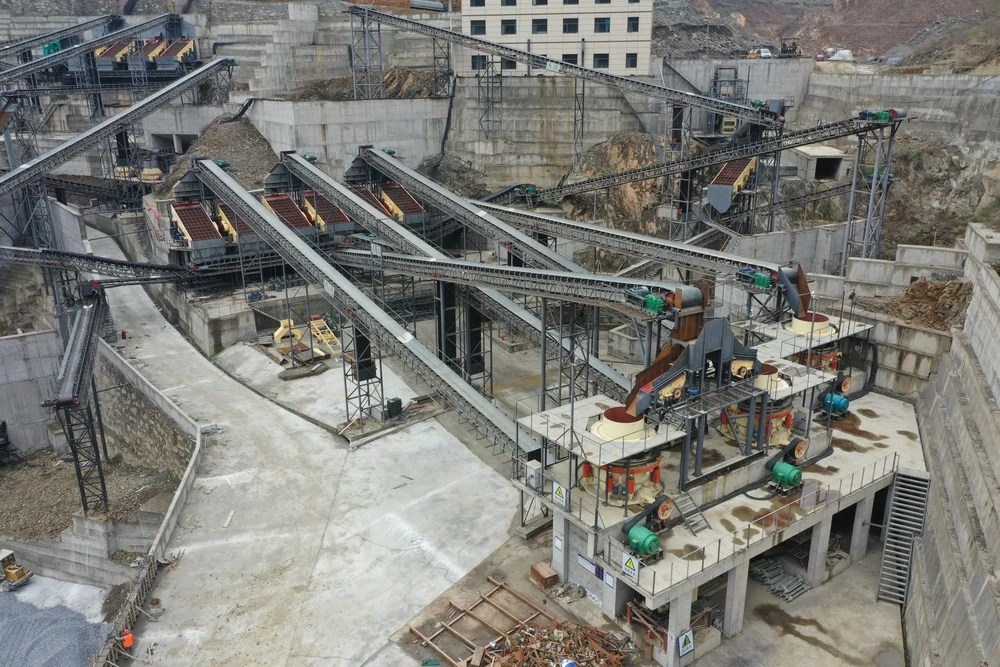
A typical basalt crushing and screening plant uses primary crushing, secondary crushing and product screening. A further cone-crushing stage or shaping circuit can be added when the required reduction or particle shape justifies it.
Typical process:
Receiving hopper → vibrating feeder with scalping where appropriate → jaw crusher → buffer bin and controlled feeding → cone crusher → multi-deck vibrating screen → separate product stockpiles.
Screen oversize returns to a suitable crushing stage.
Primary crushing: prepare feed for the cone crusher
The jaw crusher reduces quarry feed to a size suitable for downstream processing. Scalping can remove suitable fines ahead of the crusher, but those fines must be assessed before being blended into a finished product.
Cone crushing: match the product range
Cone chamber selection and closed-side setting, or CSS, affect the discharge distribution. Choose the CSS together with the feed characteristics, target product sizes and screen arrangement.
Simply tightening the CSS does not guarantee better plant performance. It changes the balance between finished stone, fines and circulating material.
Screening: separate products before further crushing
The product screen directs accepted fractions to stockpiles and oversize back to the crushing circuit. Screen area, deck arrangement, feed distribution and bed depth all matter.
If saleable stone is incorrectly carried into the return stream, it is crushed again. This can reduce coarse aggregate yield while increasing fines and wear.
Shaping: add it for a defined requirement
A VSI shaping stage can be considered when the existing circuit does not meet the buyer’s particle-shape requirement. Its role should be clearly defined: improve the selected stone fraction while monitoring the additional sand and fines produced.
For coarse aggregate production, the objective is to maximize saleable stone output while keeping production cost per tonne under control.
Leimeng equipment options for coarse aggregate production
A Leimeng basalt coarse aggregate line can combine a ZSW series vibrating feeder, a PE or GC series jaw crusher, HPY multi-cylinder or DH/DS single-cylinder cone crushers, and YKJ series vibrating screens. Belt conveyors connect the crushing stages, return oversize material and deliver separate stone fractions to their stockpiles.
The cone crusher configuration depends on the feed size and required product range. Where additional fine crushing is needed, the line can include a separate cone-crushing stage rather than placing the full reduction duty on one machine.
4. Configuration for Basalt Manufactured Sand Production
A basalt sand making plant usually shares the early crushing stages with an aggregate plant. The difference becomes clearer after cone crushing.
Instead of directing most accepted stone to stockpiles, the plant routes a selected feed fraction into a dedicated sand circuit.
Typical process:
Jaw crushing → cone crushing, with an additional fine-crushing stage where needed → screening to select suitable VSI feed → buffer bin and controlled feeding → VSI sand maker → product screening → washing or dry classification where required → finished sand storage.
Oversize from product screening returns to the appropriate crushing stage, provided it meets that machine’s feed limits. Material that already meets the required sand specification can bypass unnecessary re-crushing.
This guide uses a VSI-based sand circuit as a common configuration example. The final equipment combination should follow the basalt feed characteristics and the required sand quality.
Prepare a consistent VSI feed
The VSI should receive feed within the selected model’s limits. Large fluctuations in feed size or rate make it harder to maintain a consistent product.
A buffer bin and controlled feeder help separate short-term upstream fluctuations from the sand-making stage.
Control the whole grading curve
Passing a 5 mm screen does not automatically make material suitable for use as concrete sand. Screening controls the upper product size, while classification adjusts the distribution of finer particles. The finished sand still needs to be checked against the buyer’s grading and quality requirements.
Use sieve analysis to decide whether to adjust crushing settings, return selected fractions or blend suitable streams. Further crushing should address a measured grading need.
Select wet or dry processing from the material and site
| Site condition | Processing direction to evaluate |
|---|---|
| Clean feed with excessive ultrafines; limited water | Dry classification with suitable dust collection |
| Clay or mud contamination requiring removal | Washing, with additional scrubbing if the material requires it |
| Wet processing with recoverable fine sand in the water stream | Fine sand recovery and dewatering |
| Sand already meeting the required grading and cleanliness | Avoid unnecessary additional treatment |
Stone powder and clay are different. Removing every fine particle can damage the grading and reduce product yield.
In a wet circuit, washing removes contamination that can be separated by the selected process. Fine sand recovery captures recoverable sand from the water stream, while dewatering reduces the moisture carried with the product. These are separate duties, and the plant still needs a plan for process water and sludge. For dry processing, dust collection controls emissions; a suitable classifier is needed when the sand’s fine-particle distribution requires adjustment.
The choice between wet and dry processing also depends on water availability, feed moisture, site layout and how separated fines will be handled.
Leimeng equipment options for manufactured sand production
For basalt manufactured sand, Leimeng Group can extend the jaw-and-cone crushing arrangement with a VSI or LM series vertical shaft impact crusher. This stage processes selected feed for sand production and particle shaping, followed by screening and any required fines control.
Where wet processing is required, equipment options include LSX series screw sand washers or XSD series wheel sand washers, together with ZKX fine sand recovery equipment and ZK dewatering screens. The combination should be selected according to contamination, recoverable sand in the water stream and the required product moisture.
5. Producing Both Products: Design the Split Point
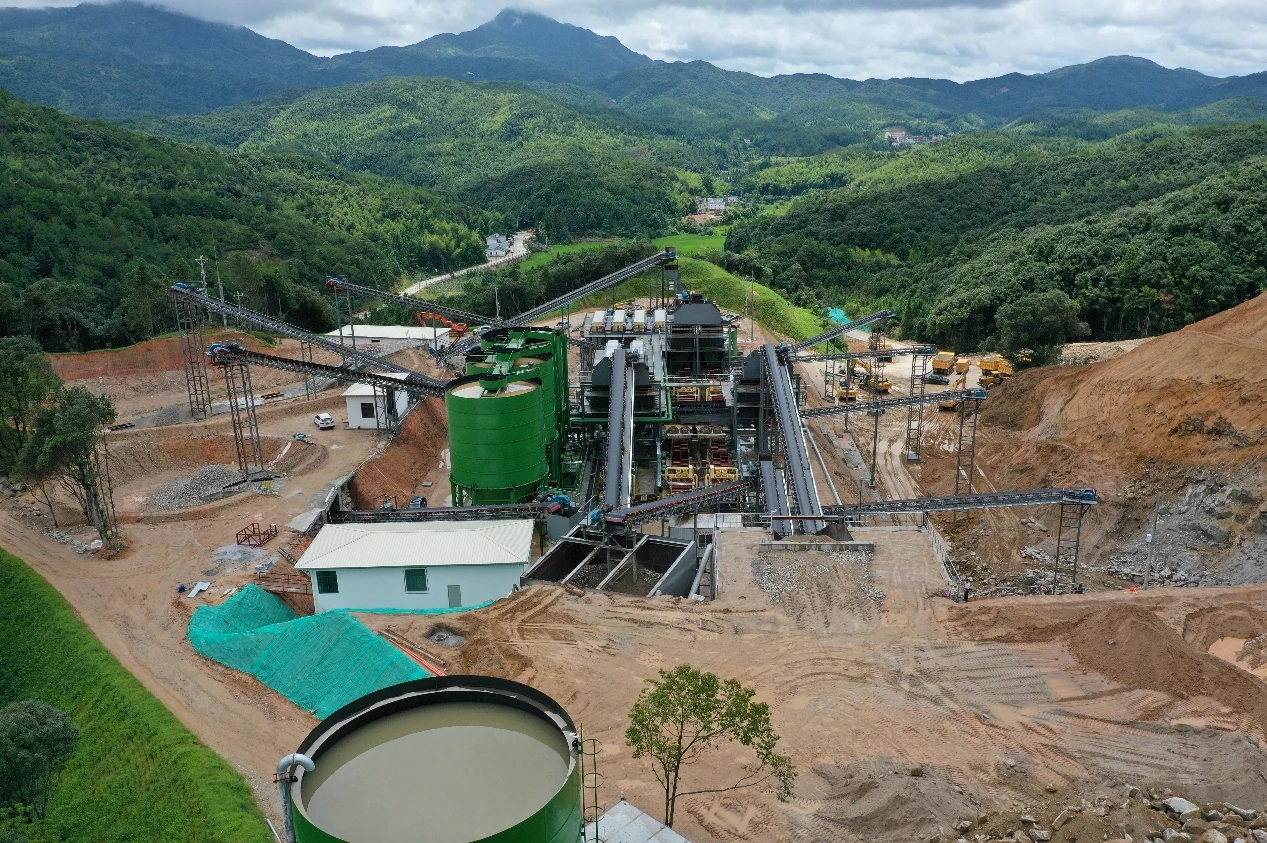
A quarry can produce coarse aggregate and manufactured sand from the same basalt feed. The key is deciding which fractions leave as finished stone and which enter the sand circuit.
For example, accepted coarse fractions can go directly to stockpiles, while a selected intermediate fraction feeds the VSI. Oversize returns to the appropriate crusher.
This arrangement allows the product mix to be adjusted within the plant’s design limits. It also avoids sending every tonne through the sand maker when coarse stone already has a buyer.
The split point should follow sales demand, product quality and a material balance.
That balance should account for fresh feed, finished products, return loads, separated fines and any washing losses.
| Production target | Leimeng equipment combination to evaluate | Configuration focus |
|---|---|---|
| Mainly coarse aggregate | ZSW feeder + PE/GC jaw crusher + HPY or DH/DS cone crusher + YKJ screens | Separate saleable stone fractions and control oversize returns |
| Mainly manufactured sand | Suitable jaw and cone crushing stages + VSI/LM sand maker + product screens | Prepare consistent sand-maker feed and control finished sand grading |
| Aggregate and sand production | Shared front-end crushing + YKJ screens + a separate VSI/LM branch | Retain required stone products and direct selected material to sand production |
| Wet sand processing where required | LSX or XSD washer + ZKX fine sand recovery + ZK dewatering equipment, as needed | Match washing, recovery and dewatering duties to the material |
These combinations illustrate Leimeng equipment options. Specific models, quantities and process arrangements depend on the feed characteristics, required product output and site conditions.
Adjusting the product split requires suitable bins, chutes and conveying routes, as well as sufficient capacity in both branches. It cannot be achieved simply by changing crusher settings.
6. Size the Plant for Saleable Output
A plant described as “300 t/h” may refer to fresh feed or a machine’s throughput. It does not establish how much accepted sand or each stone fraction will reach the stockpiles.
Consider an illustrative calculation:
300 t/h fresh feed × 35% saleable sand yield = 105 t/h sand
This example uses dry material mass. The assumed 35% yield represents saleable sand as a share of total fresh feed; it is not a predicted basalt sand yield. Actual yield depends on the feed, circuit settings and product specification. For wet sand, report moisture separately so that retained water is not counted as additional sand production.
Therefore, evaluate:
- Saleable output by fraction.
- Screen and conveyor loads, including returns.
- Power and wear cost per tonne of accepted product.
- Water, fines and sludge handling where applicable.
- Stockpile separation and loading requirements.
A larger crusher will not resolve an undersized screen or return conveyor.
7. Leimeng Group Basalt Plant Configuration Support
Leimeng Group supplies crushing, screening, sand-making, washing and conveying equipment for aggregate production lines. For a basalt project, the proposal can cover the equipment combination, process flow, product split, return circuits and plant layout.
A coarse aggregate proposal focuses on the required stone fractions. A manufactured sand proposal adds suitable feed preparation and sand-processing stages. For clients planning both products, the crushing and screening arrangement can be connected to a separate sand-making branch.
If an existing basalt plant needs to add sand production, send us the current equipment list and process flow together with the target sand output. This information helps assess the connection points and the additional loads on screens and conveyors.
To discuss a project, provide:
| Project information | Why it matters |
|---|---|
| Basalt sample information, photos and available test results | Assess material variability and processing requirements |
| Maximum feed size and feed distribution | Select the primary stage and downstream feed preparation |
| Required output of each product | Establish the product split and equipment loads |
| Buyer’s grading and quality requirements | Define screening, shaping and fines-control duties |
| Moisture and clay content | Evaluate pre-treatment and wet or dry processing |
| Water, power and site conditions | Develop a practical plant layout |
| Existing equipment, if expanding a quarry | Assess how a new circuit can connect to the current plant |
| Project location | Assess local site conditions and project delivery requirements |
Planning a basalt crushing plant? Send Leimeng Group your project location, maximum feed size, required product sizes and target output in t/h. Let us know whether you plan to sell coarse aggregate, manufactured sand or both, so we can discuss the equipment combination and process layout for your project.
FAQ
What is the main difference between a basalt aggregate plant and a sand plant?
An aggregate plant prioritizes graded stone fractions. A sand plant needs further size reduction and closer control of sand grading and fines.
Why can return loads reduce plant output?
Return material occupies crusher, screen and conveyor capacity. High returns should prompt checks of crushing settings and screening performance.
What should be confirmed before choosing equipment models?
Confirm the feed characteristics, required output by product, buyer specifications and site conditions. Equipment models should follow that assessment.